

Law firms are discovering that attracting clients online takes much more than putting up a good-looking website. Over 60 percent of legal clients now begin their search for an attorney on the internet, yet most law firms barely scratch the surface of what actually brings in high-quality leads. Most people think all you need is keywords and a few blog posts but the real edge comes from deeply understanding your ideal client’s needs and matching those to your unique legal expertise. The strategies that separate thriving legal practices from the rest will probably surprise you.
Quick Summary
| Key Point | Explanation |
|---|---|
| 1. Identify your ideal client profile | Analyze current clients to determine specific legal needs and characteristics that align with your expertise. |
| 2. Optimize website for SEO with keywords | Use targeted, relevant keywords throughout your site to attract clients searching for specific legal services. |
| 3. Create content addressing client concerns | Develop engaging content that answers common legal questions and resonates with potential clients’ needs. |
| 4. Use social media for client engagement | Leverage social media platforms to showcase expertise, build relationships, and provide valuable legal insights. |
| 5. Track and adjust marketing strategies continually | Regularly evaluate your digital marketing performance and refine strategies based on analytics to enhance client acquisition. |
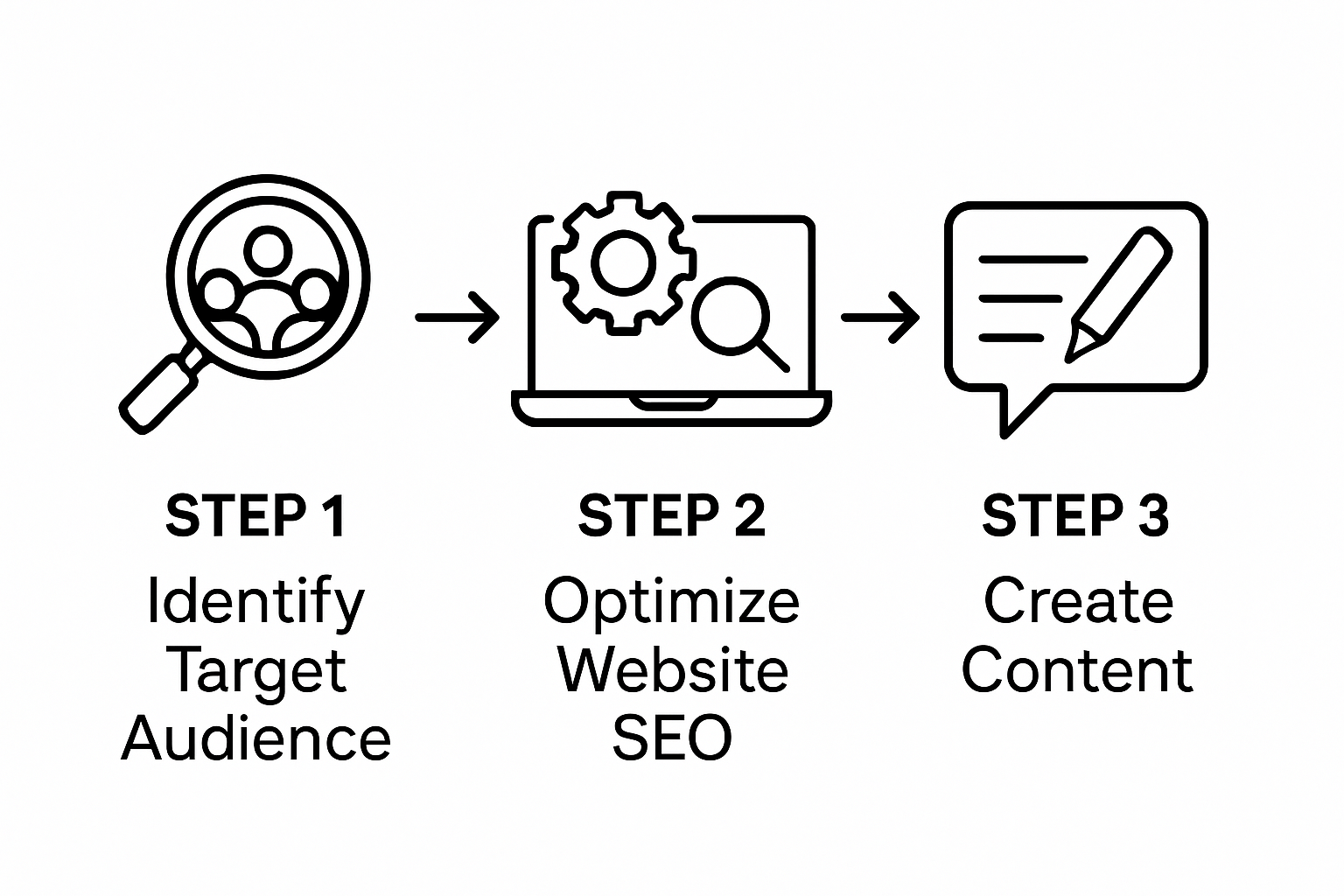
Step 1: Identify Your Target Audience and Niche
Successfully attracting law clients online begins with a crystal clear understanding of exactly who you want to serve. Your target audience isn’t just a broad demographic its a precise group of potential clients whose specific legal needs align perfectly with your professional expertise and practice areas.
Start by conducting a detailed examination of your current client base and the types of cases you handle most effectively. Analyze the common characteristics of your most successful and satisfying client interactions. Are they small business owners facing contract disputes? Individuals navigating complex family law challenges? Accident victims seeking personal injury representation? Each detail matters when defining your ideal client profile.
According to research from the University of Houston’s Small Business Development Center, understanding your target audience requires examining comprehensive characteristics including values, lifestyle, challenges, and specific legal pain points. This means going beyond basic demographics like age and income to truly comprehend the psychological and emotional drivers that lead someone to seek legal representation.
To refine your niche, consider your unique strengths as a legal professional.
 What specialized knowledge or experience sets you apart from other attorneys in your practice area? Perhaps you have an engineering background that makes you exceptional at intellectual property cases, or you speak multiple languages, allowing you to serve diverse community populations more effectively. These distinctive qualities transform you from a generic legal service provider into a targeted solution for specific client needs.
Your niche selection should balance your professional passion with market demand. Research local legal needs, examine community trends, and identify underserved areas where your expertise can provide maximum value. This strategic approach ensures you are not just choosing a target audience but creating a meaningful connection with potential clients who genuinely need your specialized legal services.
Step 2: Optimize Your Law Firm’s Website for SEO
Search engine optimization transforms your law firm’s online presence from invisible to irresistible. Your website isn’t just a digital business card it’s a powerful client acquisition tool that requires strategic technical and content optimization to attract potential legal clients searching for representation.
Keyword research becomes your foundational strategy. Focus on terms potential clients actually use when seeking legal help. Instead of generic phrases like “lawyer,” target specific, intent driven keywords such as “personal injury attorney in Chicago” or “divorce lawyer for child custody cases.” These precise keywords signal exactly what services you provide and match potential clients’ specific needs.
According to research from Yale University’s ‘The Verdict’ blog, most clients begin their legal service search online, making strategic keyword placement critical. Incorporate these keywords naturally throughout your website content, including practice area descriptions, attorney bios, case studies, and blog posts. Avoid keyword stuffing which can make content feel unnatural and potentially harm your search rankings.
Technical website elements dramatically impact your search visibility. Ensure your website loads quickly, functions seamlessly on mobile devices, and provides clear navigation. Create descriptive page titles, compelling meta descriptions, and include relevant internal links that help search engines understand your content’s context. Structure your website with header tags (H1, H2, H3) that incorporate target keywords and make content easily scannable.
Consider our comprehensive guide on law firm digital marketing for deeper insights into creating an SEO optimized online presence. Remember that SEO is an ongoing process requiring consistent content updates, monitoring performance metrics, and adapting to evolving search engine algorithms. Regularly review your website’s performance using tools like Google Analytics to track visitor behavior, identify high performing content, and continuously refine your optimization strategy.
Step 3: Create Engaging Content that Addresses Client Needs
Content creation is the bridge that connects your legal expertise with potential clients searching for solutions to their legal challenges. Your content must transform complex legal concepts into accessible, compelling narratives that resonate with your target audience’s specific needs and concerns.
Start by mapping out the most common legal questions and pain points within your practice area. This means diving deep into the emotional and practical challenges your potential clients face. For a personal injury attorney, this might involve creating content that explains the claims process, details compensation possibilities, and addresses the overwhelming feelings victims experience after an accident. Your goal is to provide clarity, demonstrate empathy, and showcase your professional understanding.
According to research from Yale University’s publication, authoritative blog posts can significantly enhance your firm’s online visibility by generating valuable backlinks and establishing thought leadership. Focus on creating long form, in depth articles that thoroughly explore legal topics, provide practical insights, and demonstrate your specialized knowledge. Each piece of content should answer specific client questions, offer actionable advice, and subtly highlight your firm’s unique approach to solving legal challenges.
Diversify your content strategy to maintain audience engagement. Mix written blog posts with video explanations, infographics that break down complex legal processes, and short social media clips that provide quick legal tips. Check out our guide on law firm SEO content writing to refine your approach. Remember that potential clients are not just seeking legal information they are looking for a trusted advisor who understands their specific situation.
Verify the effectiveness of your content by tracking key metrics such as page views, time spent on page, social shares, and most importantly, client inquiries generated. Content that consistently attracts and converts potential clients indicates you are successfully addressing their needs and positioning your firm as a go to resource for legal guidance.
Step 4: Leverage Social Media Platforms Effectively
Social media transforms from a casual communication platform to a strategic client acquisition tool for modern law firms. Your social media presence should demonstrate professional expertise while humanizing your legal practice, creating connections that transform online interactions into potential client relationships.
Prioritize platforms where your target audience actively seeks legal information. LinkedIn offers a professional networking environment perfect for connecting with business clients and displaying thought leadership. Facebook provides opportunities for community engagement and localized targeting, while Instagram can showcase your firm’s human side through behind the scenes glimpses and professional achievements. Each platform requires a nuanced approach tailored to its specific audience and communication style.
Below is a comparison table to help you choose the most effective social media platforms for your law firm, based on target audience and strengths.
| Platform | Audience Type | Key Strength |
|---|---|---|
| Professionals, Businesses | Networking, Thought Leadership, B2B Visibility | |
| Local Community, General Public | Community Engagement, Local Targeting | |
| Younger Demographics, General Public | Brand Humanization, Visual Storytelling | |
| General Public | Real-Time Updates, Legal News Sharing | |
| YouTube | All Demographics | Educational Video Content, Trust Building |
According to research from Northwestern Law Review, lawyers who use social media strategically by offering practical information and demonstrating thought leadership build significant online reputation. Create content that provides genuine value such as brief legal explanations, case study insights, and answers to common legal questions. Avoid overly technical language and focus on making complex legal concepts accessible and understandable.
Explore our comprehensive law firm social media marketing strategies to refine your approach. Develop a consistent posting schedule that maintains audience engagement without overwhelming followers. Use a mix of educational content, firm achievements, client testimonial highlights, and occasional personal insights that showcase your team’s personality and professional commitment.
Verify your social media effectiveness by tracking key metrics: engagement rates, follower growth, content shares, and most critically, the number of direct inquiries or consultations generated through these platforms. Success means transforming social media from a passive communication channel into an active client acquisition strategy that builds trust, demonstrates expertise, and positions your law firm as an approachable, knowledgeable legal resource.
Step 5: Implement Paid Advertising Strategies to Reach Clients
Paid advertising represents a precision instrument for connecting directly with potential legal clients who are actively seeking representation. Unlike organic marketing strategies, paid advertising allows you to target specific demographics, geographic locations, and search intent with remarkable accuracy.
Google Ads and social media advertising platforms offer sophisticated targeting capabilities that enable law firms to reach individuals precisely when they need legal assistance. For instance, personal injury attorneys can target users searching for keywords related to accident claims, while family law practitioners can focus on individuals searching for divorce or child custody information. The key is crafting compelling ad copy that speaks directly to the potential client’s immediate legal concerns.
Design your advertising strategy with laser focused precision. Create separate ad campaigns for each practice area, ensuring that the messaging and landing pages align perfectly with the specific legal service being advertised. This means developing unique ad sets for personal injury, criminal defense, family law, and other practice areas. Each campaign should include highly specific keywords, compelling ad copy that addresses potential client pain points, and landing pages designed to convert visitors into consultation requests.
Learn more about our specialized PPC marketing strategies for law firms to maximize your online advertising effectiveness. Budget allocation is critical set aside a realistic monthly ad spend that allows for meaningful testing and optimization. Start with a conservative budget and gradually increase investment as you identify the most effective targeting and messaging strategies.
Measure your advertising success through key performance indicators such as click through rates, cost per lead, conversion rates, and most importantly the actual number of quality client consultations generated. Successful paid advertising transforms from an expense to an investment when you can track a clear return demonstrate that each advertising dollar spent directly contributes to acquiring new clients for your law firm.

Step 6: Track, Analyze, and Adjust Your Online Strategies
Tracking and analyzing your digital marketing efforts transforms raw data into actionable insights that continuously improve your law firm’s online client acquisition strategy. Digital marketing is not a set it and forget it approach but a dynamic process of constant refinement and strategic adaptation.
Implement comprehensive tracking using tools like Google Analytics, which provides deep insights into website visitor behavior, traffic sources, and conversion rates. Pay special attention to metrics that directly relate to potential client engagement such as time spent on practice area pages, consultation request form submissions, and phone call tracking. These indicators reveal not just how many people visit your website, but how effectively your digital strategies convert casual browsers into actual clients.
According to research on web best practices, understanding user experience goes beyond simple numerical metrics. Analyze the complete user journey from initial website landing to consultation request. Examine which content generates the most engagement, which advertising campaigns produce the highest quality leads, and where potential clients might be dropping off in your conversion funnel.
Review our top marketing tips for law firms to gain additional strategic insights. Establish a monthly review process where you systematically evaluate your digital marketing performance. Compare key performance indicators across different channels like organic search, paid advertising, social media, and email marketing. Look for patterns that indicate which strategies are most effective for your specific practice areas and target client demographics.
Successful tracking means being willing to make data driven adjustments. If certain practice area pages have high bounce rates, redesign their content and layout. When specific advertising keywords generate more qualified leads, reallocate your budget to double down on those high performing strategies. Your online marketing approach should be a living, breathing strategy that evolves continuously based on real world performance data.
Turn Proven Strategies Into Real Results For Your Law Firm
You have identified your target audience, learned to optimize your website, and started building engaging content. Yet, the real challenge remains: how do you put these proven strategies into action and achieve measurable growth for your law practice? Many law firms struggle to translate digital marketing knowledge into consistent client acquisition. If you feel overwhelmed by SEO, paid advertising, or the constant need for quality online content, you are not alone. Investing energy into these areas without expert support can lead to frustration and missed opportunities.
This is where LawSmiths becomes your partner for lasting success. With over 25 years of specialized experience helping attorneys stand out online, our suite of digital marketing services for law firms covers everything from results-driven SEO and content creation to advanced PPC marketing solutions. Let us turn your digital marketing plan into a powerful engine for attracting high-quality clients. Ready to accelerate your growth? Connect with LawSmiths today and discover how a customized approach can set your firm apart right now.
Frequently Asked Questions
How can I identify my target audience for legal services?
Start by examining your current client base to identify common characteristics and specific legal needs. You can also consider psychological and emotional drivers that lead potential clients to seek legal representation.
What SEO strategies should I implement for my law firm’s website?
Focus on keyword research to identify specific terms potential clients use. Optimize your website’s technical elements, create descriptive meta tags, and ensure your content is easily scannable and informative.
How can I create engaging content for my law firm?
Map out common legal questions and pain points, and create content that transforms complex legal concepts into accessible narratives. Use various formats, such as blogs, videos, and infographics, to maintain audience engagement.
What metrics should I track to measure the effectiveness of my online marketing strategy?
Monitor key performance indicators like website traffic, conversion rates, client inquiries generated, and social media engagement to assess how well your strategies are converting potential clients.

